
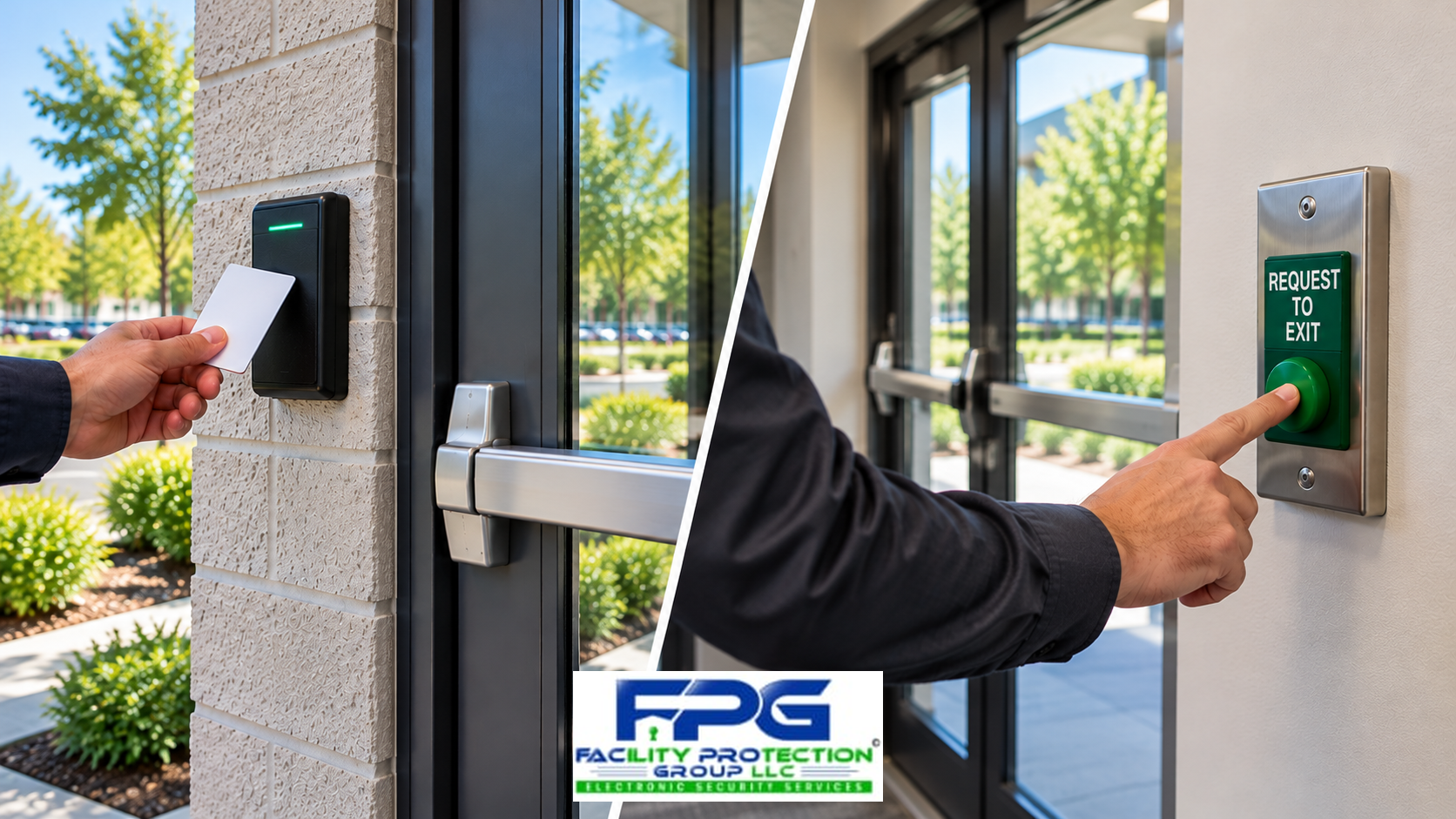
Access control emergency egress planning is an essential part of protecting a commercial building. Business owners want to prevent unauthorized entry, protect restricted areas, and control employee and contractor access. At the same time, everyone inside the building must have an appropriate means of exiting safely during an emergency.
These two objectives should work together. A properly designed access control system can restrict entry without creating unnecessary barriers to exit. Problems arise when electronic locks, door hardware, or release devices are installed without considering the building’s occupancy, required exits, and applicable life-safety codes.
For example, an employee entrance may require a credential from outside while allowing occupants to leave using ordinary interior door hardware. Another opening may use an electromagnetic lock that requires a more specialized emergency release arrangement. Although both doors are electronically controlled, their safety requirements can be significantly different.
The challenge is not simply choosing a lock that keeps a door secure. It is selecting the appropriate hardware and designing the complete system around how the building operates.
Table of Contents
- Why Is Emergency Egress Important in Access Control?
- Can Access-Controlled Doors Remain Secure and Allow Safe Exit?
- How Do Different Electronic Locks Affect Emergency Egress?
- What Happens During a Fire Alarm or Power Failure?
- What Common Installation Mistakes Create Problems?
- How Should Businesses Evaluate Their Existing Doors?
- Can Older Access Control Systems Be Improved?
- How Can Facility Protection Group Help?
Why Is Emergency Egress Important in Access Control?
Electronic access control systems are primarily intended to regulate entry. They determine whether a person has permission to enter a building or restricted area based on credentials, schedules, or other authorization rules.
Emergency egress serves a different purpose. It addresses how occupants can leave a building safely, including during a fire, power failure, or other emergency.
A door that successfully prevents unauthorized entry may still present a problem if the installed hardware interferes with required exit functions.
Consider a commercial building with several controlled entrances. During normal business hours, employees use credentials to enter, while visitors are directed through a reception area. In an emergency, however, occupants may need to leave through designated exit routes without waiting for someone to unlock a door or authorize their departure.
That is why access control design must account for more than credential readers and electronic locks. The entire opening, including the door, frame, latch, exit hardware, power supply, and applicable release devices, must support the building’s requirements.
The International Code Council publishes model building codes addressing means of egress and special locking arrangements. The requirements differ depending on the locking arrangement, occupancy, and locally adopted code edition.
Can Access-Controlled Doors Remain Secure and Allow Safe Exit?
Yes. Many commercial doors can remain secure against unauthorized entry while providing appropriate mechanical exit from the inside.
A common example is an employee entrance equipped with a card reader and compatible electrified locking hardware. Employees present their credentials to enter, but occupants inside can operate the designated exit hardware without presenting a card or entering a PIN.
This arrangement separates entry authorization from the ability to leave.
Other openings require different solutions. An electromagnetic lock, for example, may depend on an approved electrical release arrangement. Depending on the installation, additional devices or system interfaces may be required.
Businesses should not assume that adding a request-to-exit button or motion sensor automatically makes an electronically locked door compliant. Those components must be installed as part of a permitted arrangement that satisfies the applicable requirements.
A professional assessment helps determine whether the existing door hardware supports both the intended security function and the required means of egress.
How Do Different Electronic Locks Affect Emergency Egress?
Commercial access control systems use several types of electronic locking hardware. Understanding their differences helps explain why one solution may be appropriate for a particular opening while another may not.
An electric strike is installed in the door frame and works with compatible mechanical locking hardware. Depending on the configuration, it can restrict entry electronically while allowing occupants to operate the interior door hardware for exit.
An electrified lockset incorporates electronic control into a mechanical locking assembly. Certain products allow credential-controlled entry while maintaining mechanical egress through the interior lever or other approved hardware.
An electromagnetic lock, commonly called a maglock, uses electrical power to hold a door closed. Because the locking force depends on electricity, the system must provide the release functions required for that particular installation.
These differences also affect how locking devices respond to electrical failure.
Fail-Safe and Fail-Secure Are Not the Same as Safe Egress
A fail-safe lock releases when power is removed. A fail-secure lock remains secured against entry when power is removed. However, neither description alone establishes whether a door meets emergency egress requirements.
For example, a fail-secure electric strike may be appropriate where the interior mechanical hardware still allows occupants to exit. A fail-safe electromagnetic lock may require additional release features beyond simply losing power.
The correct solution depends on the complete door assembly, not an isolated product specification.
Facility managers evaluating electronic locks should consider how each door is used, whether panic or fire exit hardware is required, and whether the proposed equipment is compatible with the opening.
What Happens During a Fire Alarm or Power Failure?
Fire alarms and electrical failures are important considerations when planning access-controlled doors.
Some approved electronic locking arrangements require automatic release when specified fire protection systems activate. Others operate through mechanical exit hardware or different code-permitted release methods.
The requirements are not identical for every electric strike, electrified lockset, or electromagnetic locking system.
For example, certain sensor-released electromagnetic locking arrangements require release when an occupant approaches the door, a separate manual release device, and unlocking under specified power-loss and fire protection conditions.
Other permitted arrangements use door-mounted release hardware that directly interrupts power to the electric lock.
These distinctions matter because a facility cannot assume that every electronic lock should be connected to a fire alarm in the same manner.
Backup power also requires careful consideration. A battery may keep the access control controller operating during an electrical outage, but it must not defeat the emergency release functions required for the locking arrangement.
Businesses should have the system evaluated against the locally adopted building and fire codes. The applicable authority having jurisdiction determines whether the installation satisfies those requirements.
For additional guidance, the National Fire Protection Association publishes widely used life-safety standards, including NFPA 101. The locally adopted code editions and applicable authority requirements govern each installation.
What Common Installation Mistakes Create Problems?
One of the most common problems occurs when a business focuses on securing an entrance without evaluating the door’s required exit functions.
For example, an organization may decide to add an electromagnetic lock to a previously unsecured entrance. The equipment may appear straightforward, but the installation can involve specific requirements for release devices, fire protection interfaces, and door hardware.
Another issue arises when an older system is modified. A contractor may replace a controller, power supply, or locking device without reviewing the original installation and its emergency release functions.
Over time, a facility may have several generations of access control equipment installed by different contractors. Documentation may be incomplete, and staff may not fully understand how the system should operate during an emergency.
A third concern involves relying too heavily on software. Access control software is useful for managing credentials, schedules, and security events, but required egress functions must not depend on an unreliable or impermissible software-controlled release path.
Facility managers should also be cautious about doors that are routinely propped open because employees find the access control arrangement inconvenient. This behavior can undermine security and may create additional problems involving fire-rated openings.
These situations demonstrate why access control equipment should be evaluated as part of the complete door and building security system.
How Should Businesses Evaluate Their Existing Doors?
A useful assessment begins by identifying which doors are electronically controlled and how those openings are used throughout the day.
A main employee entrance may experience frequent traffic, while an equipment room or administrative office may have relatively limited access. Emergency exits and fire-rated doors can introduce additional requirements that differ from ordinary interior openings.
Each door should be evaluated according to its intended function, existing hardware, and applicable building requirements.
The review should consider whether occupants can operate the required exit hardware, whether electronic locks respond correctly to applicable release conditions, and whether the installed components are compatible with the door assembly.
Facility managers should also understand how their system behaves during power interruptions, fire alarm activation where relevant, and access control communication failures.
The objective is not to assume that every existing door is unsafe. It is to identify which openings operate appropriately and which may need further investigation or improvement.
A comprehensive assessment can also reveal opportunities to improve credential management, door monitoring, and overall building security.
For a broader explanation of system components and planning considerations, visit Facility Protection Group’s Commercial Access Control Guide, which covers access control systems and related security technologies in greater depth.
Can Older Access Control Systems Be Improved?
Many businesses operate access control systems that have been in service for years. Although the original installation may have met the facility’s needs, building operations, security expectations, and applicable requirements can change.
An older system may use outdated readers or controllers while the door hardware remains suitable for continued use. In other situations, the locking equipment or release arrangement may require closer examination.
An upgrade does not necessarily mean replacing every door or rebuilding the entire system.
Depending on the existing installation, improvements might involve modernizing access control electronics, updating credential technology, replacing incompatible locking components, or improving the documentation and testing of required release functions.
The important step is determining what can be retained safely and what needs to change.
For organizations with several buildings or numerous controlled openings, a phased approach may help prioritize improvements without creating unnecessary operational disruption.
A security assessment should also consider how access control interacts with other building technologies. Video surveillance, intrusion detection, and emergency communication systems may contribute to broader security operations, but those integrations must not interfere with required egress functions.
FPG’s Integrated Security Systems Guide provides additional information about coordinating security technologies while considering facility operations.
How Can Facility Protection Group Help?
Facility Protection Group helps commercial organizations evaluate their security needs and develop practical access control solutions.
When a business is considering electronic locks or upgrades to existing controlled entrances, the planning process should include the door’s intended function, existing hardware, operational requirements, and applicable life-safety considerations.
FPG can help identify outdated access control components, recommend appropriate security technologies, and coordinate project planning with the professionals responsible for door hardware, fire protection, and code compliance.
This approach is particularly important for facilities with multiple entrances, older equipment, or changing access requirements.
The goal is to improve security without creating avoidable complications for employees, visitors, or building operations.
Need to Improve Access Control Without Compromising Emergency Egress?
A secure commercial building should protect against unauthorized entry while maintaining the required means for occupants to leave safely.
Whether your organization is installing electronic locks, replacing an older access control system, or evaluating existing controlled doors, reviewing the complete installation before making changes can help identify potential security and life-safety concerns.
Facility Protection Group can help your business evaluate its access control requirements, identify appropriate improvements, and develop a practical plan that considers both building security and emergency egress.
Contact Facility Protection Group to Discuss Your Access Control Project