
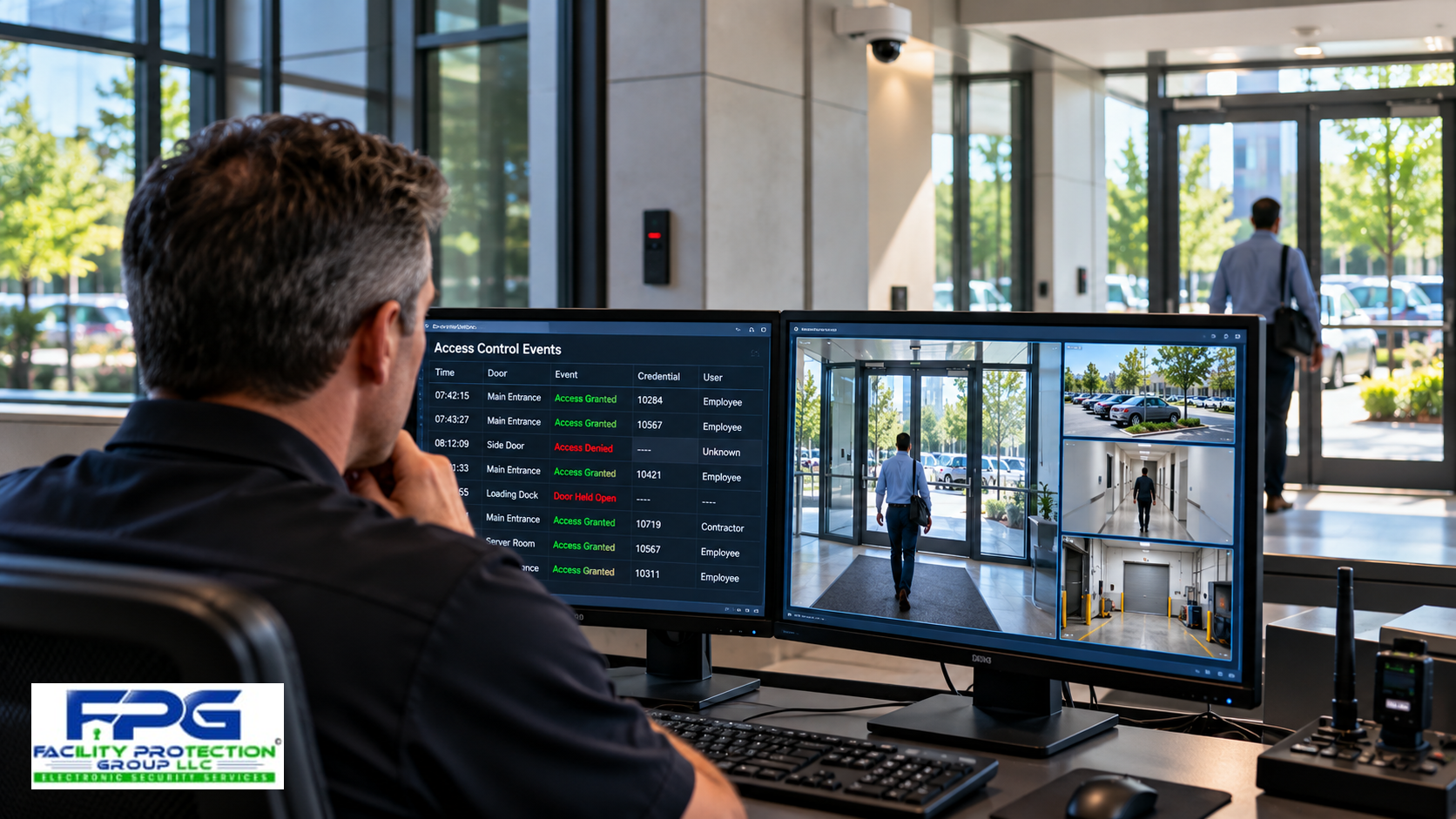
Access control & video surveillance integration can help businesses understand not only when a door was opened or a credential was used, but also what was happening at that entrance. When these systems operate independently, security personnel may have to piece together information from separate records, video timelines, and software applications to determine what occurred.
For a commercial property owner or facility manager, this disconnect may not seem important during ordinary business operations. Employees enter with assigned credentials, cameras record activity, and the building appears secure. The limitations often become apparent when someone questions an entry, reports suspicious activity, or needs to investigate an incident.
An access control system may record that a credential was accepted at 7:42 p.m. A nearby camera may have recorded the doorway at the same time. Without integration, however, an administrator may need to locate the access event, open a separate video application, identify the correct camera, and manually search the recording.
Facility Protection Group helps commercial organizations evaluate how their security technologies work together and where better coordination could improve everyday security management.
What Happens When Access Control and Cameras Operate Separately?
Access control & video surveillance systems perform different but complementary functions. Access control determines whether a credential or authorized request should release a controlled opening. Video surveillance provides visual information about activity in the camera’s field of view.
When the systems are disconnected, each may be functioning properly while providing only part of the information needed to understand an event.
A facility manager reviewing an access report might see a sequence of successful credential transactions, denied attempts, or doors held open beyond a programmed period. Those records can be useful, but they do not necessarily explain the circumstances surrounding each event.
Meanwhile, the video system may contain relevant footage without any direct reference to the access transaction. Finding that footage may require additional effort, particularly at properties with numerous cameras, doors, and daily transactions.
This becomes more complicated in facilities with multiple tenants, employee shifts, contractors, or delivery personnel. A routine question about who entered a particular area can become a time-consuming review of unrelated records.
Why Doesn’t an Access Granted Event Tell the Whole Story?
An access granted event confirms that the access control system accepted a credential or authorization under its programmed rules. It does not necessarily prove the identity of the person who passed through the doorway.
For example, an employee may present an authorized card and hold the door for a coworker. A visitor might follow an employee through an entrance without presenting a credential. Someone could also use a card assigned to another person.
In each situation, the access control record may be accurate while telling only part of the story.
Video can provide additional context when the camera is correctly positioned, the recording is available, and the activity is visible. An administrator may be able to compare a credential event with footage showing the people entering or leaving the area.
That distinction matters. Integration does not transform a credential transaction into proof of personal identity, nor does it guarantee that every unauthorized entry will be detected. It provides a more complete basis for reviewing what happened.
For businesses concerned about tailgating and unauthorized entry, FPG’s Commercial Access Control Guide provides a starting point for understanding the role of controlled entrances within a broader security strategy.
How Does Access Control and Video Surveillance Integration Work?
In a compatible integrated system, access control events can be associated with video from cameras monitoring the corresponding doors or areas.
Depending on the software and equipment, an administrator may be able to select an event and open associated live or recorded footage. Some platforms support event bookmarks, video pop-ups, or consolidated monitoring interfaces.
The underlying concept is straightforward: the access control system records the transaction, while the video system provides visual context. Integration helps bring that information together for review.
A door forced open alarm, for instance, may be linked to video of the entrance. A denied credential attempt may be associated with a recording showing who approached the reader. A door held open event may be reviewed alongside footage showing deliveries or employee activity.
These capabilities depend on the manufacturers, software versions, licensing, configuration, and interoperability of the installed products. Not every access control platform or video management system supports the same features.
Matching Events to the Correct Video
Accurate event verification also depends on system configuration.
Camera placement must provide a useful view of the controlled entrance. The access control and video systems should maintain accurate, synchronized time settings so that an event can be matched with the appropriate recording.
Network reliability, recording availability, and user permissions can also affect how effectively the integration operates.
For facilities considering modernization, FPG can evaluate whether existing equipment supports the desired functions or whether certain components should be upgraded.
Can Integrated Systems Make Security Investigations Easier?
When a security concern arises, administrators often need to establish a timeline of events. They may need to determine when someone entered a restricted area, whether a door remained open, or what occurred around a reported incident.
Disconnected systems require investigators to move between separate applications and manually correlate records.
With appropriate integration, the administrator may be able to start with a specific access transaction and retrieve the associated footage more directly.
Consider a commercial building where an employee reports missing equipment from a secured storage room. Access records may identify credential activity around the time of the reported loss. Video from the entrance could help establish whether individuals entered the room, whether the door was held open, or whether other activity occurred nearby.
The available evidence will depend on camera coverage, image quality, retention settings, and the completeness of access records. Integration cannot reconstruct events that were never recorded.
Nevertheless, connecting relevant records can reduce the amount of manual searching required and help investigators work with a more coherent account of the available information.
FPG’s Integrated Security Systems Guide discusses the broader role of coordinated security technologies in commercial facilities.
Which Access Events Benefit Most From Video Verification?
Not every access event requires video review. Businesses should identify the transactions and locations where visual context would be most valuable.
Restricted equipment rooms, inventory storage areas, employee-only entrances, loading docks, and entrances serving multiple tenants may warrant particular attention.
A denied access attempt at an exterior entrance may be relatively routine. Repeated denied attempts at a sensitive interior door, however, may deserve closer review. A door held open during a scheduled delivery may have a legitimate explanation, while an unexpected event after business hours may require investigation.
Integration can make it easier to evaluate these circumstances when the system supports event-based video retrieval.
Support Better Operational Decisions
Video verification can also help managers distinguish between a security concern and an operational issue.
A door repeatedly reported as held open may reflect a hardware problem, employee behavior, or delivery procedures. Reviewing footage alongside access events can help determine which explanation is most likely.
Businesses can then address the underlying problem through maintenance, staff training, revised procedures, or security improvements.
The objective is not to monitor every employee interaction. It is to make relevant security information available to authorized personnel when there is a legitimate operational need.
What Should Businesses Consider Before Integrating Existing Systems?
Before investing in access control and video surveillance integration, businesses should examine their current equipment, software, and security objectives.
Some facilities already have systems capable of communicating through supported integrations. Others may use older equipment, proprietary platforms, or software versions that limit compatibility.
A qualified security integrator should identify the installed access control panels, readers, cameras, recording equipment, and video management software. The evaluation should establish which functions are supported and whether additional licenses, updates, or hardware are necessary.
Compatibility should be verified at the product and feature level. General claims of interoperability do not guarantee that specific access events can trigger the video functions a business wants.
The ONVIF organization develops interoperability specifications for IP-based physical security products, but ONVIF compatibility alone does not establish that an access control system and video management platform support a particular event-integration workflow.
Protect the Security of Connected Systems
Integration can also create additional cybersecurity and administrative considerations.
Businesses should review user permissions, authentication, network segmentation where appropriate, software maintenance, and the handling of recorded footage and access logs.
The Cybersecurity and Infrastructure Security Agency provides practical guidance on securing connected systems, including the importance of software updates and strong authentication.
Access to sensitive video and credential activity should be limited to authorized personnel, with retention and privacy practices aligned with organizational requirements and applicable law.
Does Every Door Need a Camera and an Integrated System?
Not necessarily. Effective security planning should reflect the importance of each entrance, the activities occurring nearby, and the potential consequences of an incident.
A low-risk employee entrance may not require the same level of monitoring as a pharmaceutical storage area, server room, cash-handling location, or entrance serving a restricted manufacturing process.
Businesses should also consider whether existing cameras provide a useful view of the doorway. A camera may already cover the general area but lack the angle or detail needed for meaningful event verification.
Adding integration without evaluating camera placement can produce a technically connected system that still provides limited information.
Prioritize the Locations That Matter Most
A practical plan may begin with selected doors where access events frequently require investigation or where the organization has identified specific security concerns.
Businesses can then evaluate whether additional entrances should be included as operating needs change.
This approach may allow organizations to retain functioning equipment while improving coordination at the locations where integration provides the clearest benefit.
How Can FPG Help Improve Your Security System Coordination?
A successful integration project begins with understanding the questions a business needs its security systems to answer.
Facility managers may want to verify activity at restricted entrances, simplify investigations, review unusual credential transactions, or better understand why doors are being held open.
Facility Protection Group can assess the existing access control and video surveillance infrastructure, identify compatibility limitations, and recommend practical options for connecting relevant events with useful video.
The goal is to improve the information available to security personnel and facility managers without introducing unnecessary complexity.
Make Your Access Control & Video Surveillance Work Together
If your organization relies on separate access control and video surveillance systems, you may be spending more time than necessary reviewing security events and investigating activity at controlled entrances.
Facility Protection Group works with commercial businesses and facility managers to evaluate existing security systems and develop solutions based on the property’s actual requirements.
Would your business benefit from easier access-event verification and more useful security information? Contact Facility Protection Group to discuss access control and video surveillance integration for your facility.