
For business owners and facility managers, the challenge is recognizing when an older access control system has become difficult to manage, expensive to maintain, or inadequate for the building it protects. A system that still unlocks a door is not necessarily providing the level of security, accountability, and administrative control the business needs today. The ability to grant and revoke credentials, maintain reliable door operation, and understand who is authorized to enter specific areas may be more important than whether the original hardware still functions.
Facility Protection Group helps organizations evaluate commercial security systems and identify improvements that address actual operational concerns. Before replacing equipment, however, it is important to understand what an aging access control system may be costing your business and which problems a thoughtful upgrade should solve. The goal is not simply to install newer technology. It is to establish an access control solution that better supports the building, its occupants, and the people responsible for managing security.
Table of Contents
When Is an Access Control System Upgrade Necessary?
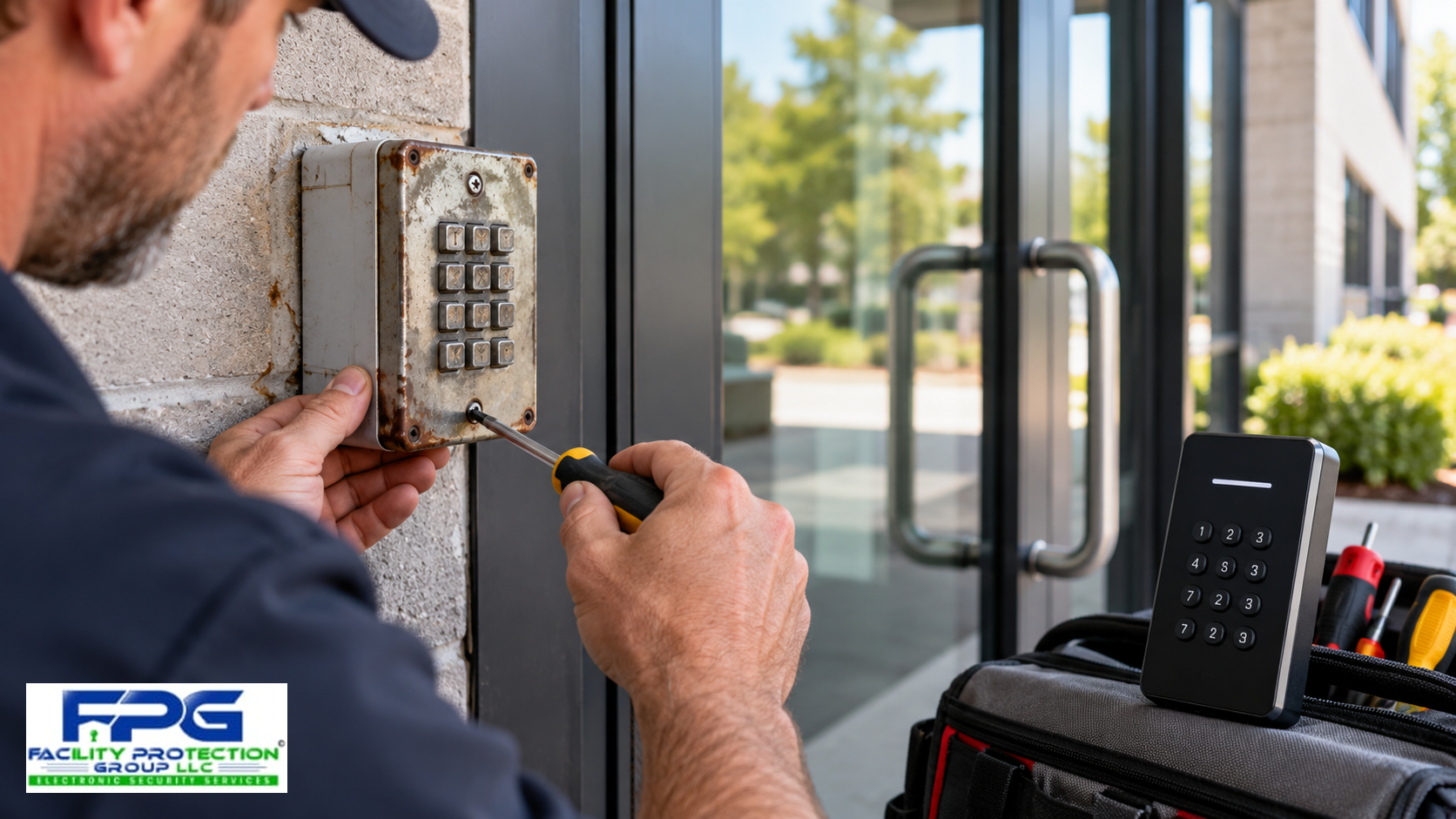
One of the most obvious warning signs is deteriorating equipment. An older stainless steel keypad may show corrosion, worn buttons, damaged seals, or signs of repeated repairs. Readers may become unreliable, and aging door hardware may require increasingly frequent service. While individual components can often be repaired or replaced, recurring problems may indicate that the overall system deserves a closer evaluation. Waiting until a critical entrance stops functioning can turn a manageable improvement project into an urgent service problem.
Other warning signs are less visible. A facility manager may discover that adding a new employee requires an outdated computer, specialized software, or assistance from someone who originally installed the system years ago. Removing access privileges may involve several manual steps, and administrators may struggle to determine which credentials remain active. These limitations can create unnecessary work and increase the likelihood that access permissions are not maintained consistently. An access control system should make routine security administration more dependable, not more complicated.
When Older Equipment Becomes Difficult to Support
Electronic access control equipment depends on more than the keypad or reader mounted beside a door. Controllers, power supplies, locking hardware, communication networks, and management software must work together. If a manufacturer no longer supports an important component, replacement parts are difficult to obtain, or software cannot operate reliably on current computers, routine maintenance can become a significant operational concern. Even a relatively minor failure may take longer to resolve when compatible components are no longer readily available.
Support limitations do not automatically mean an entire system must be replaced. Some installations can benefit from targeted improvements while retaining compatible infrastructure. Others may have reached a point where continued repairs preserve old limitations rather than resolving them. Understanding that distinction is an important part of planning a cost-effective upgrade, particularly for businesses that must maintain access to occupied facilities throughout the installation process.
When the Building Has Outgrown Its Original Security Design
A system installed for a small office may no longer meet the needs of a business with multiple departments, additional entrances, restricted storage areas, or changing employee schedules. Contractors and service providers may require temporary access, while managers may need different permission levels for specific areas of the facility. A growing organization may also want centralized management across several entrances rather than separate procedures for individual doors.
These changes can expose weaknesses in how access is administered, even when the equipment itself remains operational. For example, an organization that once issued a handful of permanent credentials may now need to manage frequent employee turnover, temporary vendors, and different operating hours. If the existing system cannot support those requirements efficiently, the business may rely on workarounds that are difficult to supervise. Evaluating the original design against current operating needs can reveal whether a targeted improvement or a broader modernization project would provide greater long-term value.
How Can Outdated Access Control Put Your Business at Risk?
An aging access control system can create security concerns that extend beyond occasional equipment failures. When credentials are not managed consistently, former employees or contractors may retain access longer than intended. When entry records are limited or unavailable, facility managers may have difficulty investigating unusual activity or confirming whether an authorized person entered a restricted area. These weaknesses may develop gradually, making them easy to overlook until a specific incident reveals the limitations of the system.
Older credential technologies also deserve attention. Some legacy proximity cards and key fobs use identification methods that offer less protection against duplication than properly configured modern encrypted credentials. That does not mean every older card has been compromised, but it does mean organizations should understand the capabilities of the readers and credentials they currently use. A security assessment can determine whether existing technology is appropriate for the building’s risk level and whether stronger credential authentication would be beneficial.
Operational Disruption and Unnecessary Security Workarounds
Security weaknesses are not always caused by unauthorized activity. An unreliable reader, failing controller, or malfunctioning electric lock can interfere with normal business operations. Employees may be delayed at an entrance, managers may need to arrange emergency service, or staff may begin using inconvenient workarounds to keep daily activities moving. When these situations become routine, the business may gradually lose the consistency that electronic access control was intended to provide.
Door security also depends on the condition of the surrounding hardware. A modern reader cannot compensate for a damaged latch, poorly aligned door, inadequate power supply, or improperly functioning request-to-exit device. During an access control system upgrade, these supporting components should be evaluated alongside the electronics. The objective is to maintain reliable authorized entry while preserving appropriate emergency egress and safe building operation.
Should You Upgrade Your Existing System or Replace It?
Replacing every component is not always necessary. A business with dependable controllers, compatible wiring, and properly functioning door hardware may be able to improve its system by updating readers, credentials, software, or selected equipment. This approach can reduce unnecessary disruption and allow the organization to address its most important security concerns without discarding infrastructure that remains useful.
However, a more extensive replacement may be appropriate when the existing platform is no longer supported, expansion options are limited, or important components cannot communicate with current technology. A system that requires repeated repairs or relies on obsolete management software may also become more expensive to maintain over time. The right decision depends on equipment condition, compatibility, security requirements, and the cost of continued operation.
Evaluate Compatibility Before Reusing Existing Components
Compatibility should never be assumed simply because two devices operate at the same credential frequency or use similar wiring. Readers, controllers, credential formats, and software platforms must be evaluated as a complete system. In particular, moving from older proximity technology to encrypted credentials may require coordinated changes to both readers and credential enrollment procedures. Reusing incompatible equipment can undermine the benefits of an otherwise well-planned modernization project.
A qualified commercial security provider can review the current installation, identify equipment that remains serviceable, and develop an upgrade plan around the building’s operational needs. This evaluation should include the doors themselves, the existing control panels, available network infrastructure, and the way administrators currently issue and revoke access. A phased approach may be practical for occupied facilities that cannot interrupt normal business activities.
What Improvements Can Modern Access Control Provide?
Modern commercial access control systems can offer improvements in security management, administrative efficiency, and flexibility. Depending on the platform selected, authorized personnel may be able to manage credentials from a central interface, establish schedules for different employee groups, and update access permissions without visiting each individual entrance. Some systems also support remote administration, allowing designated managers to respond to routine access requests while away from the facility.
Credential options have also expanded. Businesses may choose appropriately secured cards, key fobs, PIN-based access, or supported mobile credentials according to the requirements of each entrance and user group. Stronger credential authentication can improve protection against certain forms of duplication, while clearly defined permissions can help organizations limit access to areas where it is genuinely required. These improvements are most effective when paired with consistent administrative procedures and regular credential reviews.
Better Visibility Into Building Activity
Many modern systems can maintain access event records that help administrators review credential activity and investigate specific incidents. These records can provide useful information about which credential was presented at a controlled entrance and whether access was granted or denied. However, an access event alone does not prove who physically passed through a doorway, particularly when multiple people enter together. Businesses requiring additional visual verification may benefit from integrating access control with appropriately positioned video surveillance.
Modernization should ultimately make building security easier to manage without adding unnecessary complexity. The most valuable improvements are those that solve specific problems, such as simplifying employee onboarding, reducing dependence on obsolete equipment, or providing better control over sensitive areas. Selecting features based on actual operating requirements helps avoid investing in technology that offers little practical benefit.
Considering an access control system upgrade? Facility Protection Group can help evaluate aging equipment, identify compatibility concerns, and recommend improvements suited to your building’s security and operational needs. A professional assessment can help determine whether targeted modernization or a broader system replacement is the more appropriate investment.
What Should You Evaluate Before an Access Control System Upgrade?
A successful access control system upgrade begins with understanding the building rather than selecting equipment from a product catalog. A business should first determine which entrances require electronic control, who needs access to each area, and how permissions should change throughout the day. These requirements may differ considerably between an office entrance, warehouse loading area, equipment room, and restricted storage space.
The evaluation should also consider the condition of existing door hardware, controllers, wiring, power supplies, and network connections. Some components may remain suitable for continued use, while others may limit the performance or reliability of a modern system. Reviewing these conditions before installation helps identify potential complications and supports a more realistic project budget.
Plan for Credential Management and Future Growth
Credential administration deserves particular attention. Businesses should establish who can issue access permissions, how employee departures are handled, and when temporary contractor credentials expire. A modern system can simplify these responsibilities, but technology alone cannot replace clear security procedures. The National Institute of Standards and Technology provides useful guidance on physical access authorizations and credential management in its security requirements for protecting controlled information. Although those requirements address a specific federal information-security context, the underlying practices illustrate the value of maintaining accurate access permissions.
Future expansion should also influence the selection process. An organization may need to add controlled doors, integrate another building, or connect access events with video surveillance. Choosing a platform that supports realistic future requirements can reduce the likelihood of another premature replacement. Facility Protection Group’s commercial access control systems overview explains how centralized management and scalable security solutions can support different commercial facilities.
Protect Emergency Egress During Modernization
Electronic access control must never be evaluated independently of life safety. Door locking arrangements, fire alarm interfaces where required, emergency release functions, and applicable building codes should be reviewed before equipment is changed. An installation that improves control over entry must also preserve the ability of occupants to exit safely during an emergency.
The Occupational Safety and Health Administration explains important workplace exit-route requirements in its exit-route design and construction standard. Applicable building and fire codes may impose additional requirements depending on the occupancy and locking arrangement. A qualified security integrator should coordinate these considerations with the appropriate building professionals and authorities having jurisdiction.
Consider Installation Timing and Business Continuity
Replacing access control equipment in an occupied facility requires careful scheduling. Employees, visitors, deliveries, and service contractors may need uninterrupted access while technicians work on individual entrances. A phased installation can help reduce disruption, particularly when a business operates multiple shifts or maintains restricted areas that cannot be left unsecured.
Before the new system becomes operational, administrators should understand how credentials will be enrolled, permissions assigned, and equipment tested. Existing credentials may need to be replaced if the new platform uses a different technology. Planning these changes in advance helps prevent confusion on the first day of operation and gives employees a clear transition from the older system.
Is It Time to Upgrade Your Building’s Access Control System?
An aging access control system does not always require immediate replacement. However, recurring service problems, unsupported software, outdated credentials, and difficult administration are legitimate reasons to examine whether the existing installation still meets the needs of the business. The longer these issues remain unresolved, the more likely they are to affect daily operations or create avoidable security weaknesses.
The most effective modernization projects begin with a professional assessment of existing conditions and a clear understanding of the facility’s security objectives. In some buildings, replacing selected readers or updating management software may be sufficient. In others, a coordinated replacement of controllers, credentials, and supporting hardware may provide better reliability and long-term value. The right solution should address current problems while allowing reasonable room for future growth.
Facility Protection Group can help you determine the next step. If your business is experiencing problems with an aging keypad, unreliable card readers, obsolete access control software, or an installation that no longer supports your operations, our team can evaluate the existing equipment and recommend practical improvements. Explore our commercial access control solutions and request a security assessment to discuss an upgrade strategy for your facility.