
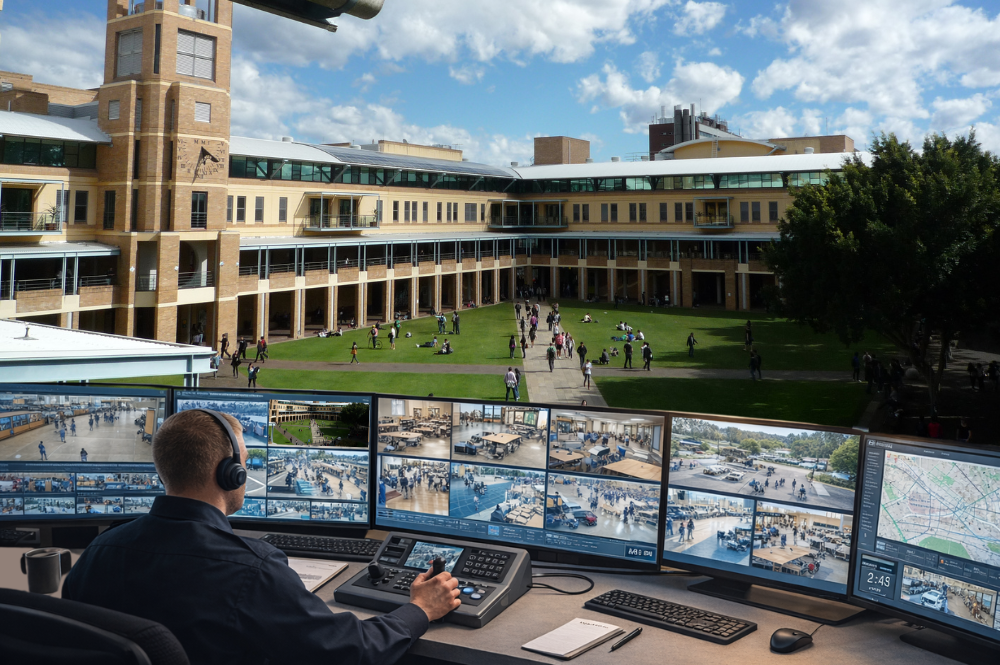
Video Surveillance for Educational Facilities is entering a decisive period in 2026 as school districts, colleges, and universities face rising operational complexity, heightened risk awareness, and increasing expectations for accountability. Education leaders and facilities decision-makers are no longer evaluating cameras as standalone devices. They are reassessing how surveillance systems support safety, compliance, and day-to-day campus operations.
Executive Summary
Educational environments are facing a convergence of technical, operational, and governance challenges that are reshaping how video surveillance systems are planned and deployed. Legacy assumptions around coverage, storage, and monitoring are proving insufficient for modern campus demands.
This article outlines the five most critical security challenges educational facilities must address in 2026 and explains why an integrated, forward-looking approach to video surveillance is essential for long-term resilience and institutional confidence.
The Shifting Security Landscape for Educational Institutions
Educational facilities operate as open environments by design, balancing accessibility with safety. In 2026, that balance is harder to maintain as campuses expand, technology stacks fragment, and oversight expectations increase. Video surveillance systems are now expected to deliver more than recorded footage after an incident.
Decision-makers are being asked to justify system investments not only in terms of security, but also operational efficiency, regulatory alignment, and long-term scalability. These pressures expose gaps that were manageable in the past but are now operational risks.
Challenge 1: Legacy Infrastructure Limiting Video Surveillance for Educational Facilities
Many schools and universities continue to rely on aging camera systems installed years ago to meet basic coverage requirements. These systems often lack the resolution, reliability, and integration capabilities needed for modern campus environments.
As facilities expand and learning models evolve, legacy infrastructure creates blind spots and operational friction. Maintenance costs increase, downtime becomes more frequent, and compatibility with newer security platforms diminishes.
From a planning perspective, outdated systems restrict future decision-making. Leadership teams are forced to choose between piecemeal upgrades or comprehensive modernization without clear guidance on long-term impact.
Key implications of legacy infrastructure include:
- Reduced image clarity impacting incident review and investigations
- Inability to integrate with access control or emergency communication systems
- Increased maintenance and replacement risk over time
Challenge 2: Data Management and Retention Pressures
Video Surveillance for Educational Facilities generates significant volumes of data, and in 2026, data governance is a growing concern for education leaders. Retention requirements, storage limitations, and internal access controls must all be carefully managed.
Institutions are increasingly scrutinized on how long video is stored, who can access it, and how it is protected. Poorly designed systems can expose schools to compliance risk, internal disputes, or operational inefficiencies.
Without a clear data management strategy, facilities teams often make reactive decisions that lead to fragmented storage environments and inconsistent policies across campuses.
Common data-related challenges include:
- Unclear or inconsistent video retention policies
- Storage architectures that do not scale with campus growth
- Limited visibility into who accesses recorded footage
Challenge 3: Integrating Video for Educational Facilities Surveillance Into Broader Campus Security Systems
In 2026, standalone surveillance systems are increasingly viewed as insufficient. Education decision-makers expect Video Surveillance for Educational Facilities to function as part of a cohesive security ecosystem.
When video systems operate in isolation, response times suffer and situational awareness is limited. Integration with access control, intrusion detection, and communication systems enables more informed decision-making during both routine operations and critical incidents.
The challenge lies in designing systems that integrate cleanly without introducing unnecessary complexity or vendor lock-in. This requires thoughtful system architecture and experienced integration planning.
Integration gaps often result in:
- Delayed response during security events
- Manual processes that strain staff resources
- Limited real-time visibility across large campuses
Challenge 4: Staffing and Monitoring Constraints
Educational institutions are facing staffing pressures across multiple departments, including facilities and security operations. Video Surveillance for Educational Facilities must account for limited personnel availability and realistic monitoring capabilities.
Expecting staff to actively monitor dozens or hundreds of cameras is not operationally sustainable. Poorly designed systems overwhelm teams with alerts or require constant manual oversight.
Leadership teams must evaluate how surveillance systems support staff workflows rather than add complexity. This includes considering system usability, centralized management, and intelligent configuration aligned with real-world operations.
Operational staffing challenges typically include:
- Overreliance on manual camera monitoring
- Alert fatigue reducing system effectiveness
- Training gaps caused by complex interfaces
Challenge 5: Planning for Scalability and Future Risk
One of the most overlooked challenges in Video Surveillance for Educational Facilities is long-term planning. Systems installed today must remain viable as campuses grow, regulations evolve, and risk profiles change.
Short-term decisions focused solely on immediate needs often lead to costly redesigns later. In 2026, education leaders are under greater pressure to demonstrate that security investments align with long-term institutional strategy.
Scalability is not only a technical concern but a governance issue. Systems must support phased expansion, evolving policies, and integration with future technologies without disruption.
Long-term planning risks include:
- Systems that cannot scale across multiple facilities
- Inflexible architectures limiting future upgrades
- Increased total cost of ownership over time
What Education Leaders Should Be Evaluating Now
For decision-makers, these challenges highlight the need for a more structured evaluation approach. Video Surveillance for Educational Facilities should be assessed as a strategic infrastructure component, not a standalone security purchase.
Effective evaluation focuses on system design, integration readiness, operational impact, and governance alignment. Institutions that address these areas proactively are better positioned to manage risk and maintain confidence among stakeholders.
At a minimum, leadership teams should ensure surveillance planning aligns with broader campus security objectives and operational realities.
A Consultative Path Forward
Addressing these challenges requires more than selecting new cameras or software. It requires collaboration between education leadership, facilities teams, and experienced commercial security integrators who understand institutional environments.
A consultative assessment can help identify gaps, prioritize investments, and align surveillance systems with both current needs and future expectations. For educational facilities navigating 2026 and beyond, this approach supports informed decision-making without introducing unnecessary complexity.
Connect With Facility Protection Group
- Website – https://facprogroup.com/
- Free Consultation Contact – https://facprogroup.com/contact-us/#
- Phone – (877) 762-6460
- Request Service – https://facprogroup.com/contact-us/#
Facility Protection Group-Electronic Security ServicesFloridaState Certified #EF0001201
Serving the Southeastern U.S.: FL, AL, GA, TN, NC, SC
FAQ – Frequently Asked Questions
How long should educational facilities retain video surveillance footage?
Retention policies vary by institution and regulation, but most educational facilities retain footage between 14 and 90 days depending on risk, storage capacity, and compliance requirements.
Should video surveillance systems integrate with access control on campus?
Yes. Integration improves situational awareness, reduces response times, and supports coordinated security operations.
Is cloud video surveillance appropriate for schools and universities?
Cloud and hybrid systems can be effective when designed with data governance, access controls, and scalability in mind.