
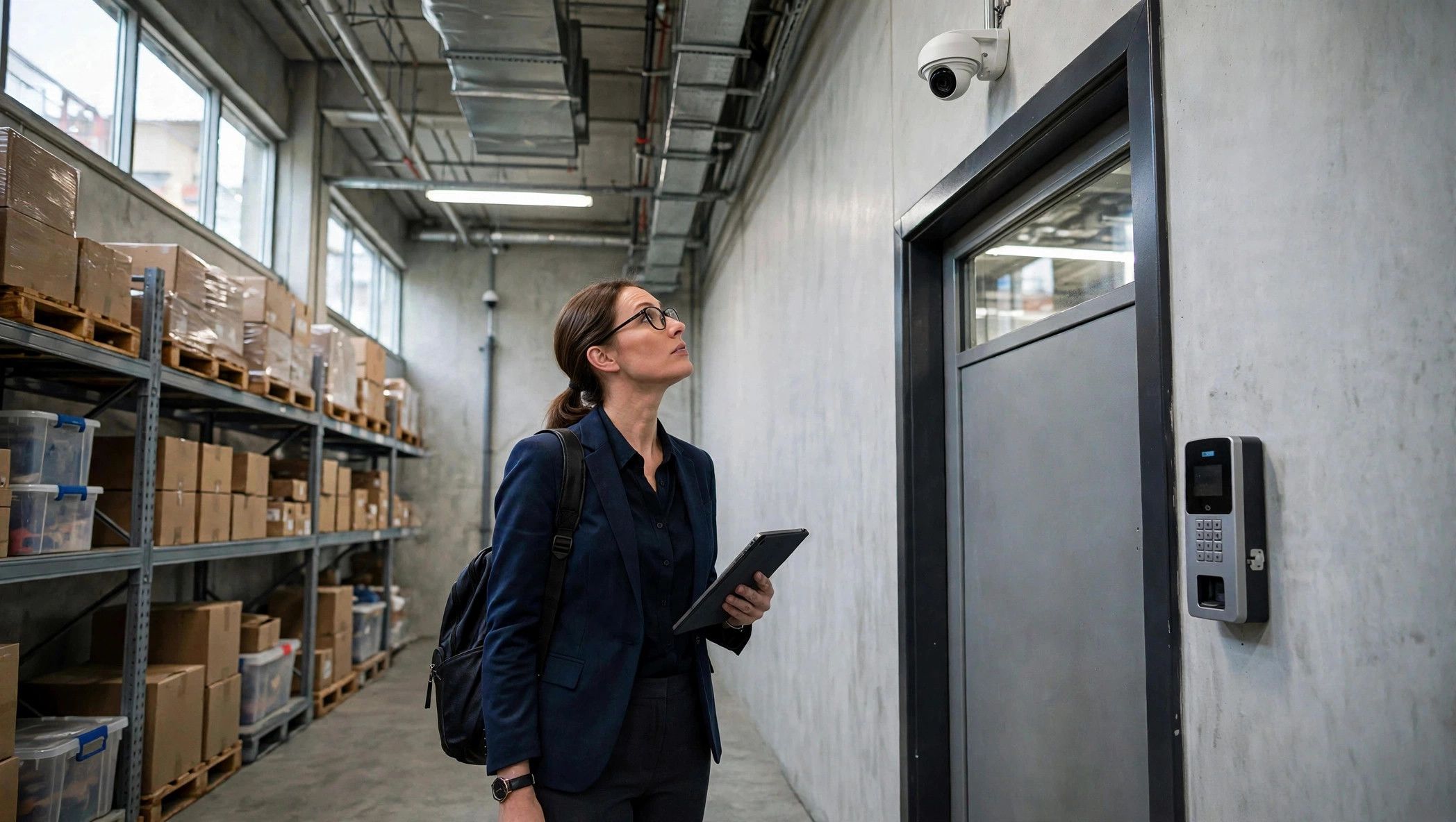
Most businesses learn about a security vulnerability the expensive way — after an incident, a loss, or an insurance review forces the issue. The uncomfortable truth is that the gap was usually there for months, walked past daily by people who had no reason to notice it. A commercial security assessment exists to find those gaps first, on purpose, while they are still cheap to fix.
An assessment is not a sales walkthrough and it is not a glance at your camera monitor. It is a structured examination of your doors, cameras, credentials, procedures, and records, measured against one question: where could someone get in, take something, or do harm without being stopped or seen? This guide explains what a commercial security assessment examines, the vulnerabilities it most often identifies, and what happens with the findings.
Table of Contents
- The Vulnerabilities You Cannot See From Your Desk
- What a Commercial Security Assessment Actually Examines
- Access Control Gaps: Doors, Credentials, and Old Permissions
- Video Blind Spots and Recording Gaps
- Where Procedures Fail Before Products Do
- What You Receive: Findings Ranked by Risk
- What Happens After the Assessment
- How Often Should an Assessment Be Repeated?
The Vulnerabilities You Cannot See From Your Desk
Familiarity is the enemy of detection. The side door that has never latched properly becomes “just how that door is.” The camera view that slowly drifted off the loading dock is still “the dock camera.” Credentials belonging to employees who left last year stay active because nobody owns the list. None of these look like vulnerabilities from inside the routine — they look like Tuesday.
An outside assessment breaks that familiarity. The assessor walks the property the way an intruder, a dishonest insider, or an auditor would: looking for the opening that is unguarded, the camera that cannot identify a face, the procedure that exists on paper but not in practice.
What a Commercial Security Assessment Actually Examines
A thorough commercial security assessment covers six areas. First, the perimeter and openings: every door, dock, gate, and window, and the hardware on each. Second, access control: who can go where, which credentials are active, and whether the records match reality. Third, video surveillance: coverage, image quality day and night, and how long recordings are actually kept. Fourth, intrusion detection and lighting. Fifth, procedures: how people are admitted, how deliveries are handled, what happens after hours. Sixth, documentation: incident history, service records, and the policies staff are expected to follow.
The method follows the same risk principles used in professional standards such as those published by ASIS International: identify the assets, identify the threats, find where the two meet without protection. And because the systems are examined together rather than one vendor at a time, the assessment also catches the seams between them — the places where, as our article on access control and video surveillance integration explains, disconnected systems quietly stop covering for each other.
Access Control Gaps: Doors, Credentials, and Old Permissions
Access control findings are usually administrative, not mechanical. The assessor samples the credential database against a current staff list, and in many facilities the two disagree: former employees, old vendors, and temporary workers whose access was never switched off. Doors get tested too — closers that no longer pull the door to latch, strikes misaligned by years of use, and at least one entrance, in most buildings, that can be opened with a firm pull.
Aging platforms make all of this harder to see, which is why the assessment also reviews the system itself; our guide to recognizing when an access control system upgrade is due covers those warning signs in depth. If the terminology in your own reports — credentials, controllers, fail-safe versus fail-secure — blurs together, the Electronic Access Control Glossary defines each term in plain language.
Video Blind Spots and Recording Gaps
Cameras fail quietly. A camera that was aimed at a door five years ago may now frame a shelving unit that was installed last spring. Night images that looked fine in a daytime demonstration can be white-outs from a nearby light or darkness beyond the camera’s infrared range. The assessment checks views at the times they matter, not just at the time of the visit.
Recording gets the same scrutiny: how many days are actually retained when the math is done, whether the recorder’s clock is right, and whether anyone could retrieve an incident from last month if asked. A system that records over the evidence before anyone looks for it is a vulnerability with a power light on it.
Where Procedures Fail Before Products Do
The most common findings are not products at all. A door propped open for convenience defeats every dollar spent locking it. A master code shared by the whole shift is not a code, it is a rumor. Deliveries waved through a controlled entrance, visitors walking unescorted, closing checks that depend on whoever remembers — each is a gap an assessor can spot in a single walk, and each costs little or nothing to correct once it is named.
This is why an honest vulnerability assessment spends as much time on habits as on hardware. Equipment recommendations made before the procedures are examined tend to buy technology to guard openings that people hold open anyway.
What You Receive: Findings Ranked by Risk
The deliverable of a commercial security assessment is a written report, and its most important feature is order. Findings are ranked by risk — likelihood multiplied by consequence — so a door that does not latch beside your cash handling area outranks a camera gap in a low-traffic corridor, and life-safety items sit above everything. Each finding should name the gap, where it is, why it matters, and what a reasonable correction looks like.
A report written this way becomes a planning document, not a scare tactic. It also serves people who were not in the room: leadership deciding on funding, an insurer asking about due diligence, a new facilities manager inheriting the building. Federal resources point the same way — CISA publishes physical security guidance for commercial facilities built on identifying and prioritizing vulnerabilities the same way.
What Happens After the Assessment
Findings divide naturally into three groups. Some are corrections to make immediately: the credential purge, the door that does not latch, the propped entrance. Some are near-term projects with a price attached. And some belong on a phased plan, funded over more than one budget cycle. Our guide to deciding which security upgrade to fund first picks up exactly where the assessment report leaves off.
What should not happen is also worth saying: a report that goes in a drawer. The assessment’s value is the order it establishes; acting on even the first tier of findings removes the vulnerabilities most likely to be used.
How Often Should an Assessment Be Repeated?
Security drifts. Staff turn over, tenants change, a remodeling project moves a wall and three camera views with it. A practical rhythm is a full assessment every two to three years, and a fresh one whenever the building changes significantly — new occupancy, an expansion, a change in what is stored or handled on site, or an incident that reveals a gap the last report rated as low. Between assessments, the quick wins from the last report — credential reviews, latch checks, camera view checks — make a sound quarterly habit.
Our Integrated Security Systems Guide shows how the assessed pieces fit together when you are ready to plan beyond individual findings.
How Can Facility Protection Group Help?
Facility Protection Group performs commercial security assessments for organizations across the Southeast. We walk the property, examine the systems and the procedures, and deliver findings ranked by risk — with the corrections separated from the projects, and no obligation attached to the report.
Contact Facility Protection Group to Schedule a Security Assessment