
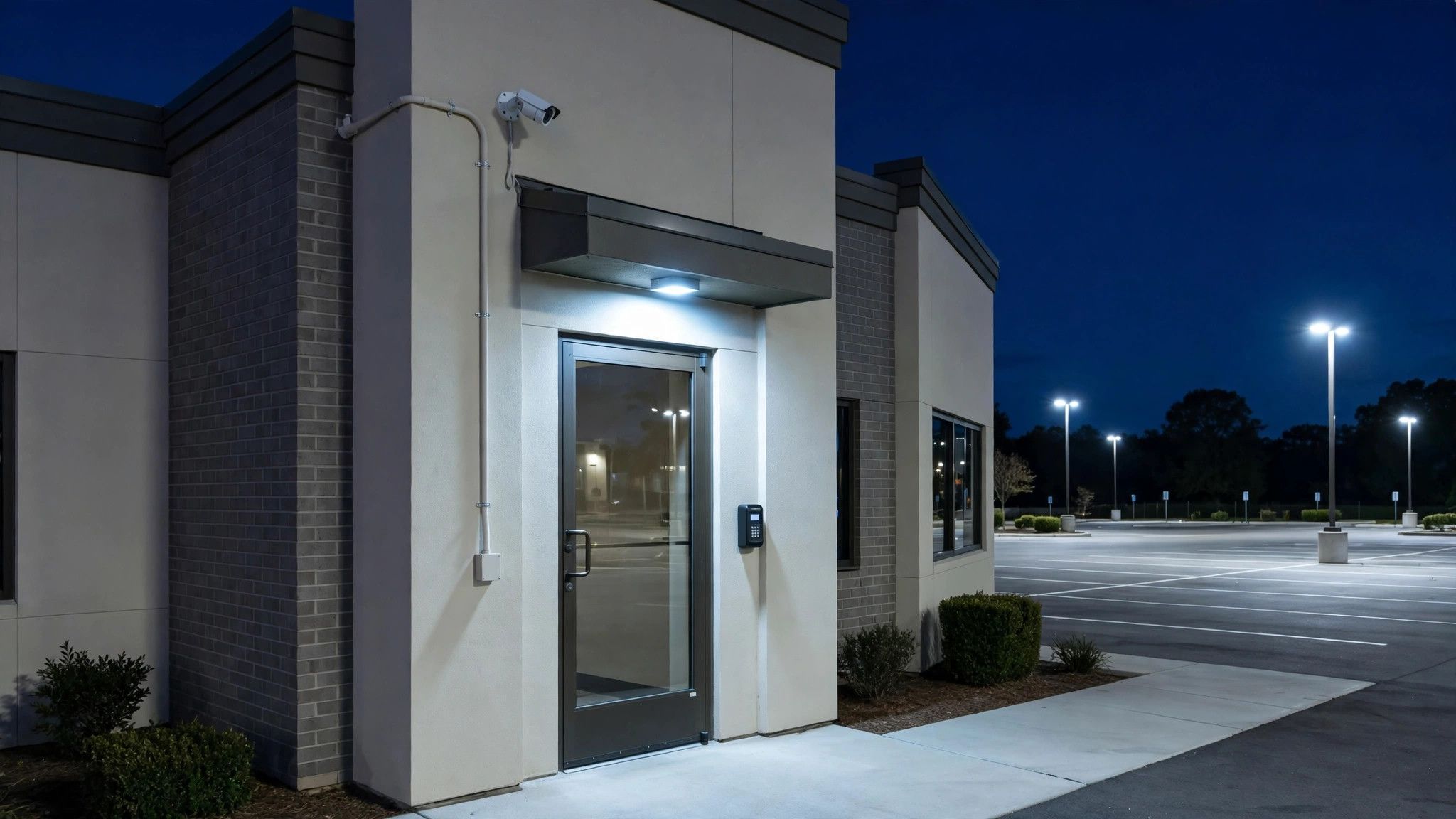
An empty building is a different building. The doors nobody watches, the corner the lights do not reach, the window behind the dumpsters — after closing time, your facility’s weakest points stop being quirks and start being invitations. Most after-hours break-ins are not sophisticated. They are crimes of patience and opportunity, committed against the darkest, quietest opening the intruder can find.
Commercial break-in prevention is therefore less about any single product than about layers: remove the darkness, harden the openings, detect the attempt in minutes, and make sure someone is told. This guide builds those layers in order — lighting, doors and locks, glass and secondary openings, detection, verified video, and after-hours access control — so you can see where your building is strong and where it is simply dark.
Table of Contents
- How After-Hours Break-Ins Usually Happen
- Start With Lighting: Remove the Dark
- Commercial Break-In Prevention Starts With Doors and Locks
- Glass, Windows, Docks, and the Roof
- Detection That Reports in Minutes, Not Monday Morning
- Video That Verifies Before Anyone Is Called
- Access Control After Hours: Schedules and Credentials
- Putting the Layers Together
How After-Hours Break-Ins Usually Happen
Talk to any investigator and a pattern emerges. The intruder arrives on foot or parks where no camera covers. He tries the openings in order of privacy, not strength: the rear door in shadow, the dock door nobody checks, the window the shrubs have grown over. Forced entry is common, but so is the quieter route — a door that was propped, a lock that was never rekeyed after a staffing change, a code the whole night shift shares.
Time is the intruder’s real budget. Anything that makes an attempt slower, louder, brighter, or more likely to be seen spends that budget for him. Every layer in this guide is aimed at the same transaction. Camera planning plays its part early, because coverage decides whether an attempt is witnessed at all; our Commercial Video Surveillance Guide covers that planning in depth. Federal guidance for commercial facilities, including the physical security resources published by CISA, is built on the same layered principle.
Start With Lighting: Remove the Dark
Lighting is the cheapest layer and the one intruders vote against most consistently. The goal is not stadium brightness; it is even, reliable light at every opening and along every approach, with no dark pocket beside a door for someone to work in. Fixtures that fail and stay failed for a season quietly unbuild this layer, so lighting belongs on the same inspection habit as the locks.
Walk the building at night, from the street, the way a stranger would. Note where a person could stand unseen within
Commercial Break-In Prevention Starts With Doors and Locks
The door is where prevention becomes physical. A solid door in a sound frame, a quality deadbolt or electrified lock, a strike that is anchored into structure rather than trim — together they decide whether entry takes ten seconds or ten noisy minutes. Hinges, closers, and latches matter just as much: the strongest lock on a door that does not fully close is decoration.
Hardware ages into weakness gradually, which is why after-hours protection includes reviewing what you already have; our article on the warning signs that point to an access control system upgrade will help you judge the electronic side. And if terms like fail-safe, fail-secure, and free egress blur together when you read a hardware quote, the Electronic Access Control Glossary defines them in plain language — the distinction matters, because entry hardware must resist force without ever trapping people inside during an emergency.
Glass, Windows, Docks, and the Roof
Intruders shop the whole envelope, not just the front door. Ground-floor glass can be strengthened with security film or replaced with laminated glazing that holds together when struck. Window locks and sensors deserve the same attention as door hardware, especially on the sides of the building nobody drives past. Loading docks combine big doors, frequent propping, and after-hours darkness — treat the dock as an entrance, with the same lighting, hardware, and detection as the front.
The roof is the opening businesses forget. Roof hatches and skylights over warehouses and stockrooms should be locked and, on higher-risk sites, alarmed. If a ladder, a dumpster, or a low adjoining roof makes the climb easy, that access route belongs in the plan too.
Detection That Reports in Minutes, Not Monday Morning
Prevention that only resists is half a system. Door contacts, glass-break sensors, and interior motion detection turn an attempt into an event — provided the signal goes somewhere. A monitored intrusion system reports in minutes to people who can act; an unmonitored siren mostly announces the break-in to an empty street.
Detection also disciplines the other layers. When every opening reports, the propped dock door becomes a notification instead of a habit, and a failed latch shows up as a door-held-open event the same night it starts, not at the next incident review.
Video That Verifies Before Anyone Is Called
Cameras earn their place after hours in two ways. First, they witness: a usable image of an intruder, a vehicle, and a timeline is what turns a report into an investigation. That requires coverage of the approaches and openings, images that work at night, and recordings retained long enough to be found. Second, and increasingly valuable, they verify. When an alarm reports, video lets a monitoring operator see whether the cause is a person in the building or a balloon in the warehouse — and verified alarms get faster, more serious responses.
Verification works best when video and access events agree with each other; our article on access control and video surveillance integration explains how the two systems corroborate an after-hours event.
Access Control After Hours: Schedules and Credentials
After hours, your credential list is your perimeter. Schedules should shrink access when the building empties: most credentials valid only during business hours, a short list valid overnight, and temporary access — cleaning crews, deliveries, contractors — issued in windows that expire on their own. Every credential belonging to a former employee that still works at 2 a.m. is an opening no lock can close.
Audit this layer the way you audit the doors. Run the active-credential report against the current staff list quarterly, delete what does not match, and treat shared codes as already compromised — because shared is what compromised means.
Putting the Layers Together
No single layer carries commercial break-in prevention; the layers cover each other’s weaknesses. Lighting exposes, hardware delays, detection reports, video verifies, and access rules shrink the list of people who can simply walk in. Professional standards such as those from ASIS International describe the same structure: deter, detect, delay, respond.
If the full build-out exceeds one budget, phase it the way risk dictates — darkest openings and weakest doors first. Our guide to prioritizing a security upgrade walks through that ordering, and our Integrated Security Systems Guide shows how the layers operate as one system once they are connected.
How Can Facility Protection Group Help?
Facility Protection Group helps commercial organizations evaluate their security needs and develop practical improvement plans. We can walk your building after hours the way an intruder would — checking the lighting, the openings, the detection, and the credentials — and turn what we find into a layered plan that fits a real budget.
Contact Facility Protection Group to Discuss Your After-Hours Security