
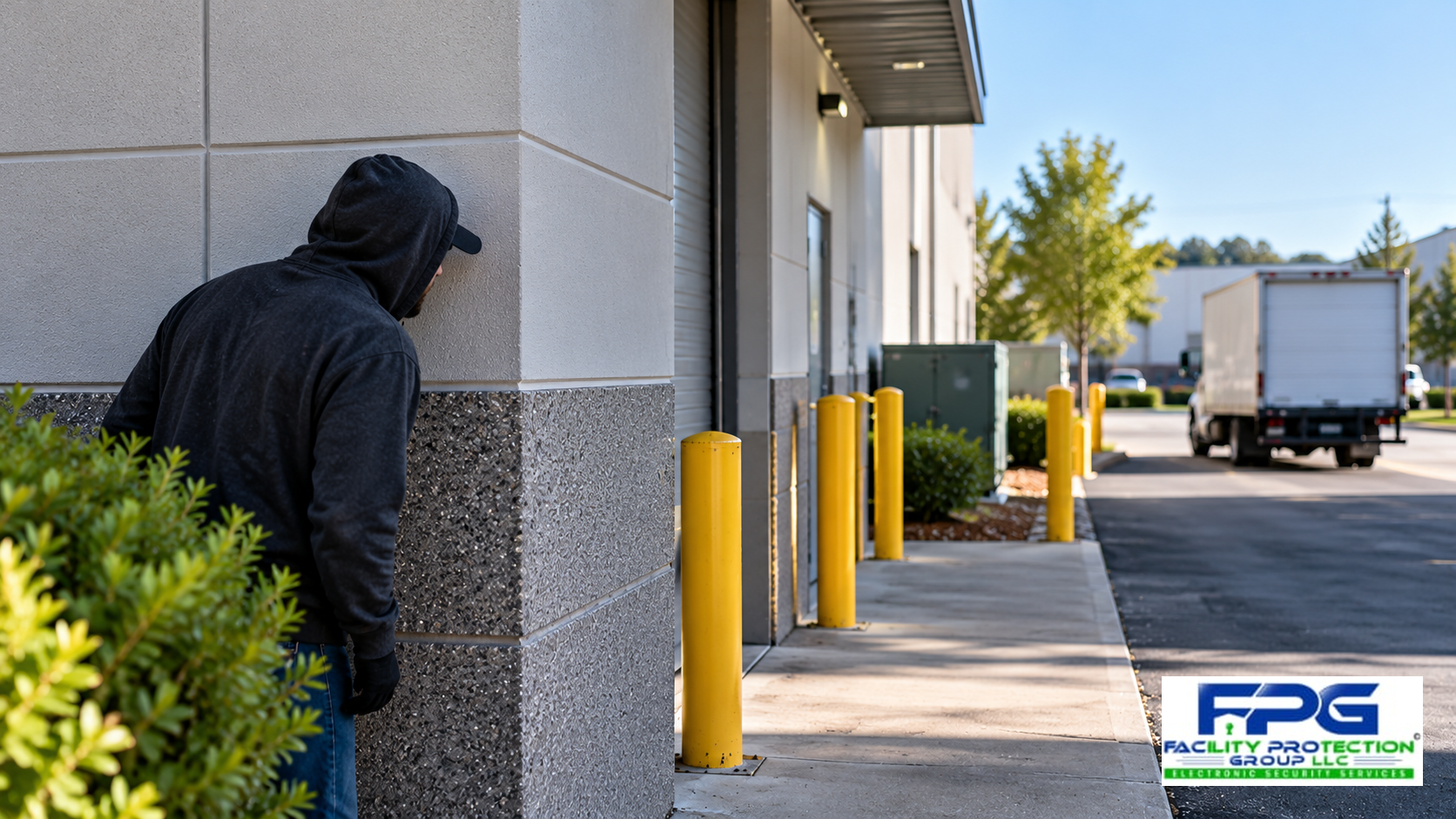
Security camera blind spots can leave commercial properties vulnerable even when a video surveillance system appears to provide extensive coverage. A business may have cameras overlooking its entrances, parking areas, loading docks, and interior spaces, yet still have locations where important activity cannot be seen clearly or recorded effectively.
These coverage gaps are not always obvious. A camera may display a wide view of an area while failing to capture useful details near a doorway. Shelving, parked vehicles, equipment, and changes in lighting can interfere with visibility. In other situations, a camera that once provided effective coverage may become less useful as the facility’s layout or operations change.
For business owners and facility managers, the concern is not simply whether an area appears on a monitor. The more important question is whether the surveillance system can provide useful information when theft, vandalism, unauthorized activity, or another incident occurs.
Facility Protection Group helps commercial organizations evaluate existing surveillance coverage and identify improvements that support their security priorities.
Table of Contents
- What Are Security Camera Blind Spots?
- Why Do Commercial Security Cameras Develop Coverage Gaps?
- Which Areas of a Business Are Most Vulnerable?
- How Can Businesses Identify Security Camera Blind Spots?
- What Solutions Can Reduce Surveillance Blind Spots?
- Can Video Analytics and System Integration Help?
- When Should You Review Your Camera Coverage?
- Building a More Effective Commercial Surveillance System
What Are Security Camera Blind Spots?
A security camera blind spot is an area where surveillance equipment cannot capture the activity or image detail needed for its intended purpose. Some blind spots are completely outside a camera’s field of view, while others are technically visible but provide footage that is too distant, obstructed, or poorly illuminated to be useful.
For example, a camera overlooking a warehouse aisle may provide a clear view of the central walkway but fail to show activity behind tall storage racks. An exterior camera may cover a parking lot during daylight but struggle to capture useful images in poorly illuminated areas at night.
These examples illustrate an important distinction between camera coverage and usable surveillance footage. A location appearing within a camera’s view does not automatically mean the system can document the activity a business needs to investigate.
Why Blind Spots Matter After an Incident
Coverage gaps frequently become apparent when a business attempts to review footage after an incident. A facility manager investigating missing inventory may discover that the relevant storage area is partially hidden from view. A property owner reviewing vandalism may find that the individual involved approached from an area outside the camera’s coverage.
In these situations, the surveillance system may be operating exactly as installed while still failing to provide the information needed.
Security camera blind spots do not necessarily indicate defective equipment. They may reflect limitations in the original design, changes to the property, or surveillance objectives that were never clearly established.
Why Do Commercial Security Cameras Develop Coverage Gaps?
Blind spots can develop for several reasons, including camera placement, mounting height, field of view, physical obstructions, and lighting conditions. A camera positioned to monitor a large area may sacrifice the image detail needed to investigate activity at a particular location.
Commercial properties also change over time. Warehouses add shelving, offices rearrange workspaces, and loading docks accommodate different vehicles. A camera installed several years earlier may no longer provide the coverage originally intended.
Environmental conditions can create additional problems. Direct sunlight, strong backlighting, shadows, and inadequate nighttime illumination may reduce the usefulness of recorded images even when a camera has an unobstructed view.
These limitations demonstrate why surveillance design requires periodic evaluation rather than assuming that cameras will continue to perform effectively simply because they remain operational.
Your content goes here. Edit or remove this text inline or in the module Content settings. You can also style every aspect of this content in the module Design settings and even apply custom CSS to this text in the module Advanced settings.
Which Areas of a Business Are Most Vulnerable?
Certain commercial locations deserve particular attention because important activity may occur outside normal employee supervision. Secondary entrances, loading docks, parking areas, storage rooms, and restricted corridors can present security concerns when surveillance coverage is incomplete.
At a warehouse, parked trailers and delivery vehicles may block cameras overlooking shipping areas. In a retail environment, shelving and displays can create hidden spaces. Office buildings may have side entrances or stairwell approaches that receive less attention than the main lobby.
The risks depend on the property. A manufacturing facility may be concerned about unauthorized access to equipment or materials, while a commercial property manager may need to document repeated damage in exterior common areas.
Businesses should prioritize coverage according to the consequences of an incident, not simply the size of the area being monitored.
How Can Businesses Identify Security Camera Blind Spots?
A practical surveillance review should begin by comparing the property’s security concerns with the views actually available from its cameras. Facility managers should examine recorded footage rather than relying exclusively on camera locations shown on a floor plan.
The review should consider whether entrances, vulnerable areas, and important activity can be seen clearly under normal operating conditions. It should also account for changes throughout the day, including variations in lighting, pedestrian movement, and vehicle traffic.
Walking through the facility while observing the corresponding camera views can reveal obstructions, missing coverage, and areas where subjects appear too small to provide useful detail. Testing should include representative daytime and nighttime conditions when relevant.
Evaluate the Quality of the Recorded Images
A camera may appear to cover an area during live viewing but produce recordings that are less useful than expected. Compression settings, recording resolution, motion-related image quality, and lighting can affect the detail available during playback.
Businesses should verify that recorded footage—not just the live image—meets the intended surveillance objective. They should also confirm that authorized personnel can retrieve the relevant recordings when needed.
The National Institute of Standards and Technology provides technical research and resources related to imaging, measurement, and security technologies. Its work reinforces the importance of evaluating technology performance against defined requirements rather than relying on specifications alone.
What Solutions Can Reduce Surveillance Blind Spots?
Correcting security camera blind spots does not always require replacing an entire surveillance system. In some cases, repositioning existing cameras, adjusting their fields of view, improving lighting, or removing obstructions can provide meaningful improvements.
Other locations may require additional cameras or equipment better suited to the intended application. A panoramic camera may improve general awareness across a broad area, while a dedicated fixed camera may provide the detail needed at a specific entrance or transaction point.
The appropriate solution depends on what the business needs to observe. Expanding coverage without establishing a clear purpose can create additional footage without improving the organization’s ability to investigate incidents.
Facility Protection Group’s Commercial Video Surveillance Guide explains the broader planning considerations involved in selecting and positioning commercial surveillance equipment.
Balance Coverage With Image Detail
A common mistake is assuming that wider camera coverage always produces better results. Increasing the field of view may allow a camera to show more of a property while reducing the detail available for people or objects within the image.
Businesses should distinguish between cameras intended to provide situational awareness and cameras expected to capture more detailed evidence. Both can be valuable, but they serve different purposes.
Facility Protection Group can evaluate existing camera views, identify coverage limitations, and recommend practical adjustments or additions based on the property’s risks and operating conditions.
Can Video Analytics and System Integration Help?
Video analytics may provide additional capabilities for detecting movement, identifying defined activity patterns, or alerting personnel to events within monitored areas. However, analytics cannot reliably detect activity that a camera cannot see or capture with sufficient quality.
Similarly, integrating surveillance with access control or intrusion detection may help personnel locate relevant footage when an alarm or access event occurs. These capabilities can improve awareness and investigation, but they do not eliminate physical blind spots.
FPG’s Integrated Security Systems Guide discusses how coordinated security technologies can support commercial security operations.
Technology should complement sound camera placement and coverage planning rather than substitute for them.
When Should You Review Your Camera Coverage?
Businesses should review surveillance coverage when security concerns change, incidents reveal missing footage, or building modifications affect existing camera views. Renovations, new storage arrangements, expanded operations, and changes in vehicle traffic can all create coverage gaps that were not present when the system was installed.
A review is also appropriate when replacing aging cameras, upgrading recording equipment, or integrating surveillance with other security technologies. These projects provide an opportunity to evaluate whether the original camera locations still support the property’s current needs.
Periodic checks should include camera positioning, image quality, lighting, recording availability, and physical obstructions. A camera that is online and recording is not necessarily providing effective coverage.
Consider Privacy and Appropriate Camera Placement
Improving surveillance coverage should not mean installing cameras indiscriminately. Businesses must consider employee and visitor privacy, the intended use of recordings, and applicable legal requirements.
Camera locations should support legitimate security objectives without unnecessarily capturing private activities or areas where surveillance may be inappropriate or restricted.
The Federal Trade Commission’s business cybersecurity resources offer guidance on protecting information and managing security responsibilities. Although these resources do not establish camera-placement rules for every jurisdiction, they provide useful context for responsible handling of recorded information.
A well-designed system balances useful security coverage with appropriate privacy and data protection practices.
Building a More Effective Commercial Surveillance System
Security camera blind spots are often the result of design limitations, environmental conditions, or changes in how a property operates. Identifying these gaps requires more than counting cameras or confirming that every device is connected.
Business owners should evaluate whether their surveillance system captures important activity, provides useful recorded detail, and supports the organization’s response to security incidents. Where gaps exist, improvements may involve camera adjustments, additional equipment, better lighting, or changes to the surveillance plan.
An effective commercial video surveillance system should evolve alongside the facility it protects. Periodic evaluation helps ensure that coverage remains aligned with changing risks and operational needs.
Start With a Professional Surveillance Assessment
Facility Protection Group helps businesses assess camera coverage, identify vulnerable areas, and develop surveillance improvements suited to their properties. Whether your organization is dealing with missing footage, recurring incidents, or an aging camera system, a professional assessment can help determine where changes will provide the greatest value.
Concerned that security camera blind spots may be leaving your business exposed? Contact Facility Protection Group to discuss your surveillance coverage and explore practical solutions for your facility.