
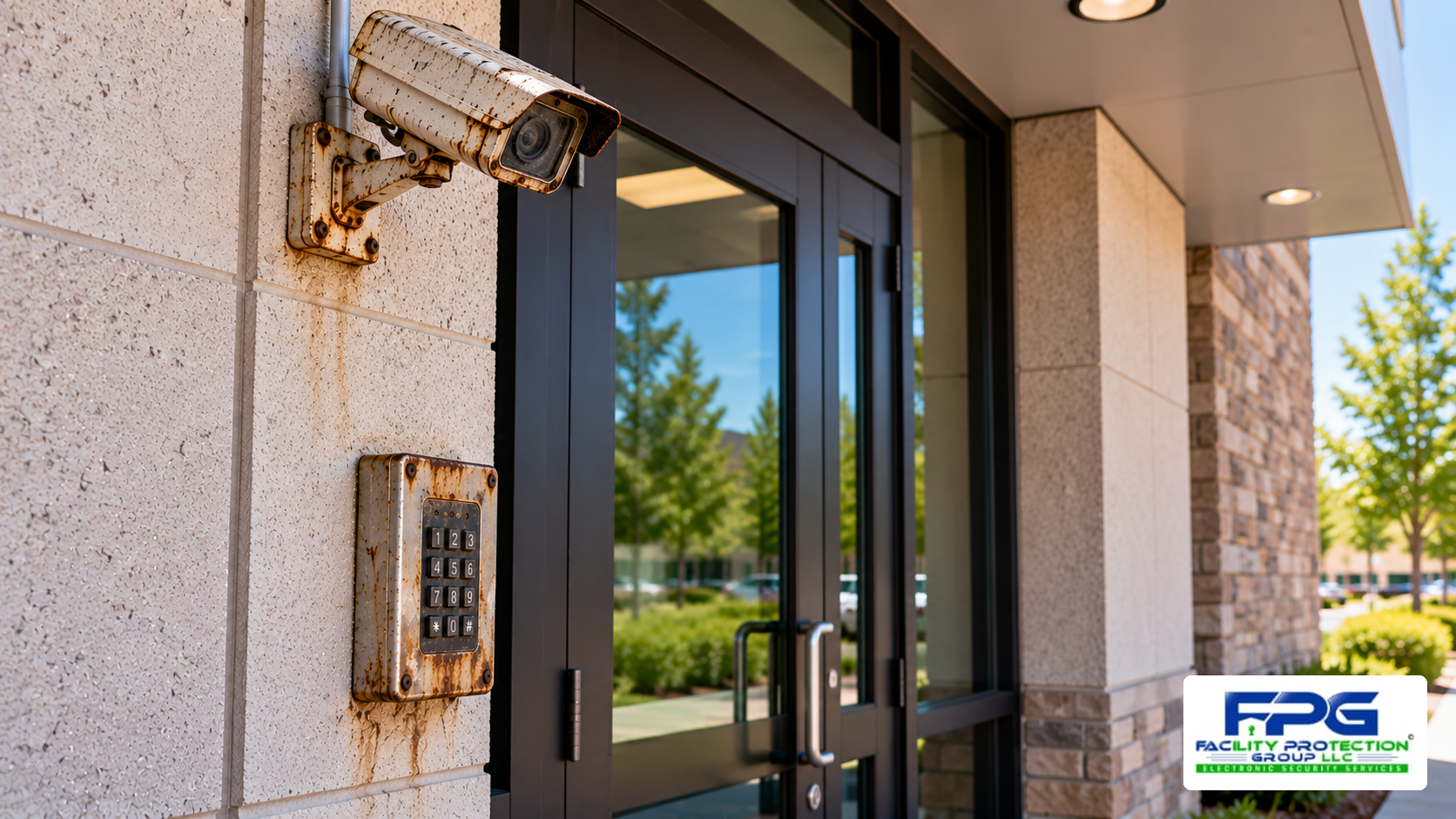
A commercial security camera upgrade may become necessary when an existing surveillance system no longer provides the image quality, reliability, coverage, or recording capabilities a business needs. Although older cameras may continue operating for years, a functioning camera is not necessarily delivering useful security information.
For commercial property owners and facility managers, the challenge is knowing when equipment has reached the point where repairs, adjustments, or replacement should be considered. A system that performed adequately when installed may struggle to meet current requirements because of changes to the building, business operations, or security risks.
New entrances, expanded parking areas, additional tenants, and changing operating hours can all affect surveillance needs. Meanwhile, aging recording equipment, outdated software, and limited compatibility with newer technology may make an existing system increasingly difficult to maintain.
Facility Protection Group helps commercial organizations evaluate their current surveillance equipment and determine whether targeted improvements or broader modernization would better address their security concerns.
Table of Contents
- How Can You Tell When Security Cameras Are Outdated?
- Are Older Cameras Providing Useful Video Evidence?
- Can Aging Surveillance Equipment Create Reliability Problems?
- Should You Repair, Upgrade, or Replace Your Security Camera System?
- Can New Cameras Work With Existing Surveillance Equipment?
- What Improvements Should a Commercial Security Camera Upgrade Deliver?
- How Can Businesses Modernize Surveillance Without Replacing Everything?
- Planning a Surveillance Upgrade Around Your Business Needs
How Can You Tell When Security Cameras Are Outdated?
The age of a camera alone does not determine whether it should be replaced. Some older commercial cameras continue to perform adequately, particularly when they are properly maintained and installed in locations with relatively simple monitoring requirements.
However, surveillance technology has changed considerably. Modern systems may offer improved image resolution, low-light performance, recording efficiency, remote management, and video analytics. Older equipment may lack some of these capabilities or be unable to support them through updates.
Warning signs include frequent recording failures, poor nighttime images, limited storage capacity, unreliable remote access, or difficulty obtaining replacement components. Businesses may also discover that their cameras cannot capture the detail needed to investigate incidents.
Look at Performance Rather Than Equipment Age
A useful surveillance evaluation begins with what the cameras are expected to accomplish.
A camera overlooking a parking area may provide adequate general awareness but insufficient detail to distinguish activity near a particular vehicle. An entrance camera may show that someone approached a doorway without capturing a clear image of the person.
These problems do not automatically mean every camera requires replacement. Adjusting the field of view, improving lighting, changing recording settings, or repositioning equipment may resolve some deficiencies.
An experienced integrator can distinguish between problems caused by aging technology and those resulting from installation or configuration.
Are Older Cameras Providing Useful Video Evidence?
One of the most important tests of a surveillance system is whether recorded footage provides useful information after an incident.
A business may discover that its cameras record activity but fail to capture identifying details, particularly when subjects are far from the camera or moving through poorly illuminated areas.
Older cameras may also struggle with challenging lighting conditions, including bright entrances, vehicle headlights, and areas with strong differences between sunlight and shadow.
Evaluate Daytime and Nighttime Recording
Camera performance should be reviewed under the conditions in which incidents are most likely to occur. A camera that appears satisfactory during daylight may provide limited information after closing.
Image resolution is important, but it is not the only consideration. Lens selection, camera placement, lighting, compression, and recording settings influence the usefulness of footage.
FPG’s Commercial Video Surveillance Guide provides additional information about designing surveillance coverage around the needs of commercial facilities.
The objective of an upgrade should be better security information, not simply installing equipment with higher advertised specifications.
Can Aging Surveillance Equipment Create Reliability Problems?
Older surveillance systems may become more difficult to maintain as recording equipment, storage drives, power components, and network hardware approach the end of their useful service life.
Some problems are intermittent. Cameras may disconnect unexpectedly, recording equipment may restart, or stored footage may become unavailable. These conditions can create security gaps that are not immediately apparent during routine live viewing.
Software support is another consideration. Equipment that no longer receives security updates may introduce cybersecurity concerns, especially when connected to business networks or accessible remotely.
The Cybersecurity and Infrastructure Security Agency provides guidance on protecting connected technology through software updates, strong authentication, and other cybersecurity practices.
Review Recording and Storage Reliability
A camera system should be evaluated as a complete recording solution. Even when cameras operate correctly, aging recorders or insufficient storage capacity can affect footage availability.
Businesses should verify that all intended cameras are recording and that footage can be retrieved for the required retention period.
FPG-B09 addresses this subject in greater detail, while an upgrade assessment should determine whether existing recording equipment can continue supporting the facility’s requirements.
Should You Repair, Upgrade, or Replace Your Security Camera System?
Not every aging surveillance system requires complete replacement. The appropriate decision depends on equipment condition, performance limitations, compatibility, maintenance costs, and the business’s current security requirements.
A relatively small problem involving a camera connection, damaged cable, or incorrect configuration may be resolved through repair.
Targeted upgrades may be appropriate when certain cameras perform poorly but the recording infrastructure remains reliable and compatible with newer equipment.
Complete replacement may be justified when major components are unsupported, frequent failures occur, or the existing architecture cannot accommodate the capabilities the business needs.
Consider Long-Term Operating Costs
Businesses should evaluate more than the immediate cost of replacement equipment.
Repeated service calls, limited parts availability, recurring failures, and inefficient system administration can increase the cost of maintaining older technology.
A professional assessment can help determine whether continued repairs represent a reasonable investment or whether modernization would provide better long-term value.
Can New Cameras Work With Existing Surveillance Equipment?
Compatibility is an important consideration when planning a commercial security camera upgrade.
Some systems use industry-supported communication standards that allow equipment from different manufacturers to operate together. Others depend on proprietary software, specific camera models, or licensed features.
Even when a new camera can connect to an existing recorder, not every capability may be supported. Resolution limits, recording formats, analytics, audio, and remote management functions can vary.
The ONVIF organization develops interoperability specifications for IP-based physical security products. Compatibility should nevertheless be verified for the actual equipment models, software versions, and functions required.
Don’t Overlook Existing Infrastructure
Cabling, network switches, power availability, and recording equipment may affect upgrade options.
A facility with older analog cameras may be able to reuse certain infrastructure through appropriate equipment, but this should not be assumed without inspection. Network-based cameras may require sufficient bandwidth and Power over Ethernet capacity.
A qualified integrator can identify which existing components remain useful and which require replacement to support a dependable installation.
What Improvements Should a Commercial Security Camera Upgrade Deliver?
A successful upgrade should solve identifiable problems rather than simply introduce newer technology.
For some businesses, the priority may be clearer images at entrances or loading docks. Others may need better nighttime performance, expanded coverage, improved remote access, or more dependable recording.
Modern video analytics may help identify certain events or locate relevant footage more efficiently when the equipment and software support those capabilities. However, analytics do not eliminate the need for appropriate camera placement and image quality.
Facility Protection Group can help businesses evaluate these capabilities alongside their existing surveillance equipment and broader security requirements.
How Can Businesses Modernize Surveillance Without Replacing Everything?
Many commercial organizations must balance security improvements against budget limitations and operational disruption.
A phased modernization strategy can help prioritize equipment that creates the greatest security concern while retaining components that continue to perform adequately.
For example, a facility may begin by upgrading cameras at frequently used entrances, loading docks, or locations where incidents have occurred. Recording infrastructure or network components may need attention first if they limit the effectiveness of all connected cameras.
The sequence should reflect actual system conditions rather than assuming that replacing individual cameras will resolve every problem.
Prioritize the Most Important Security Improvements
Businesses should consider which locations require useful recorded detail, which components are experiencing reliability problems, and where existing equipment no longer supports operational needs.
A phased plan should also account for future compatibility. Installing equipment that cannot integrate with later improvements may create unnecessary replacement costs.
Where appropriate, modernization may include better coordination between video surveillance, access control, and other security technologies.
FPG’s Integrated Security Systems Guide explains how coordinated security technologies can improve awareness and support facility operations.
Planning a Surveillance Upgrade Around Your Business Needs
A commercial security camera upgrade should begin with an evaluation of the existing system and the problems the business needs to solve.
That assessment should examine camera performance, coverage, recording reliability, equipment support, compatibility, and the facility’s current operating conditions.
A professional integrator can then recommend practical improvements, identify equipment that may remain in service, and develop an upgrade strategy appropriate for the property.
The goal is not necessarily to replace every older component. It is to ensure that the surveillance system continues providing useful information, dependable recording, and capabilities aligned with the organization’s security requirements.
Discuss Your Commercial Surveillance Upgrade With FPG
Facility Protection Group helps commercial property owners and facility managers evaluate aging video surveillance systems and identify improvements based on actual facility requirements.
Whether your business is experiencing poor image quality, recurring equipment problems, limited recording capabilities, or concerns about outdated technology, a professional evaluation can help determine the next steps.
Is your existing surveillance system still meeting your business’s security needs? Contact Facility Protection Group to discuss a commercial security camera upgrade and explore modernization options suited to your facility.