
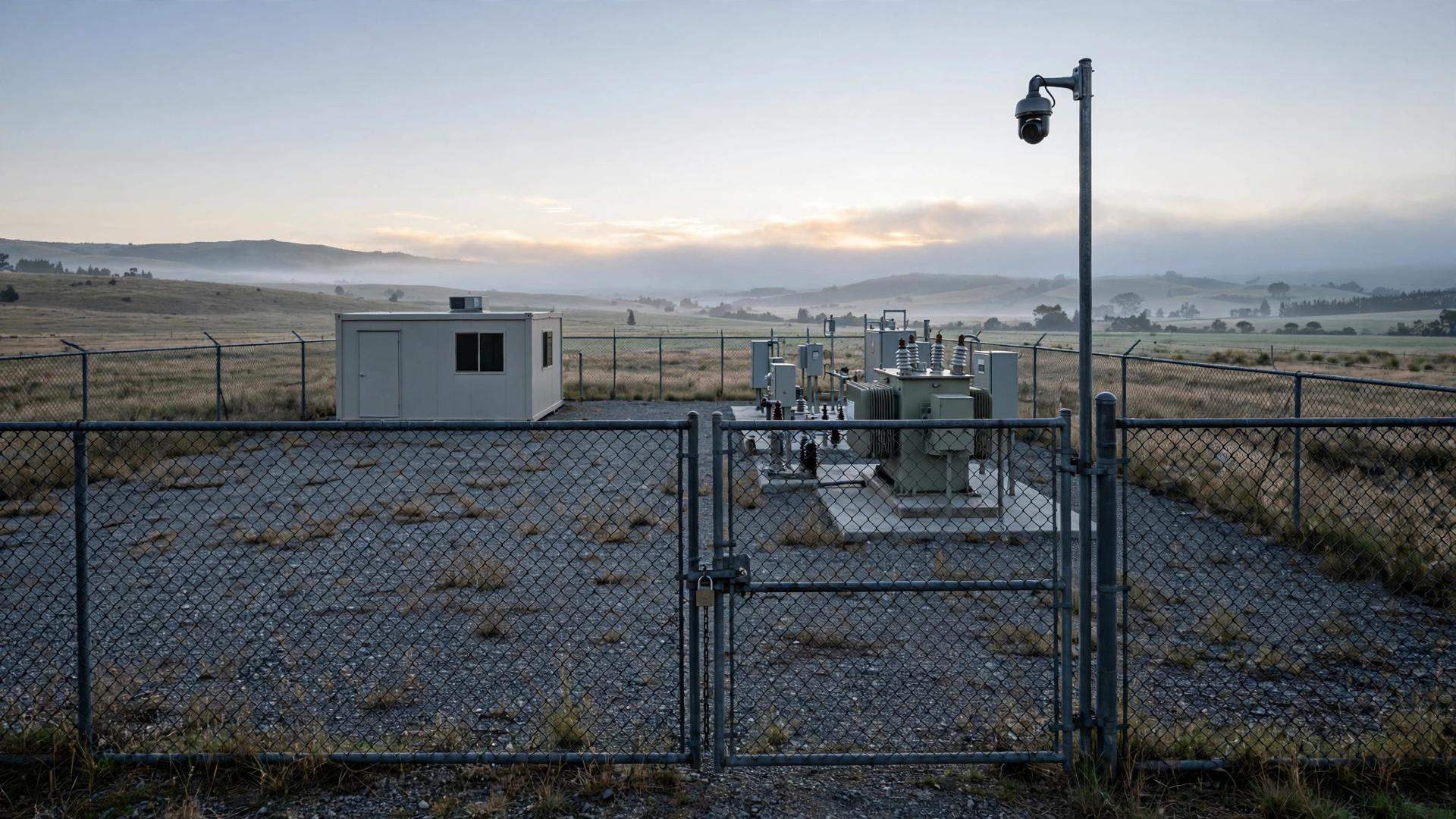
A substation, a water plant, a pump station, a tower site — the facilities a utility depends on most are the ones nobody works at. Utility facility security is what stands in for the staff those sites do not have: a fence that is actually closed, a gate that reports when it opens, and cameras that speak up in the moment instead of testifying afterward.
The threats are unglamorous and expensive: copper and equipment theft, vandalism, trespassers who injure themselves and sue, and the occasional deliberate disruption. What they share is time — an intruder at an unmanned site may have hours. The system below is built to take that time away, layer by layer, at a cost a utility can repeat across a dozen sites.
Table of Contents
- The Problem With a Site Nobody Visits
- Utility Facility Security Starts at the Fence and Gate
- Detection That Replaces the Night Watchman
- Power, Connectivity, and Staying Online
- Lights and Announcements: Answering an Intrusion Live
- Who Gets In: Crews, Contractors, and Inspectors
- When Something Happens at 2 A.M.
- Building the Plan Across a Dozen Sites
The Problem With a Site Nobody Visits
At a staffed facility, people are the detection system — they notice the stranger, hear the fence, smell the trouble. A remote site has none of that. Damage is typically discovered by the next scheduled visit, which turns a ten-minute intrusion into a total loss and leaves the investigation with weathered evidence. Critical sites carry an added weight: parts of the bulk electric system operate under federal physical-security standards, and documented protection is part of serving reliably — the Cybersecurity and Infrastructure Security Agency publishes the sector guidance most utilities plan against.
The second problem is scale. A utility does not have one remote site; it has a fleet of them, scattered across counties. Whatever the answer is, it has to be a standard kit that a crew can install, monitor, and maintain the same way everywhere — the one-administration problem our article on multi-building security systems addresses for campuses, applied here to a fleet of scattered sites.
Utility Facility Security Starts at the Fence and Gate
The fence is a delay and a declaration, and both jobs fail when it is cut, climbed, or left with a gate standing open. Start with condition: fence fabric intact, brush cleared so the line can be seen, gates that close and latch on their own. Then upgrade the gate from a padlock — which records nothing and is shared by everyone who ever had the key — to controlled access: a credentialed lock or gate operator that knows who opened it and when, and a contact that alarms when the gate is forced or held open past its minute.
That one change does double duty. It secures the site, and it gives operations a truth it never had: a record of every entry, which the next section’s detection and the crew-access discipline in this guide both build on.
Detection That Replaces the Night Watchman
Cameras at a remote site are not primarily for recording; they are the alarm system. Modern cameras with onboard analytics watch the fence line, the gate, and the equipment doors, and raise an intrusion alert on the events that matter — a person inside the fence after hours, a vehicle at the gate, motion at the control building — while ignoring the deer and weather that taught everyone to ignore the old motion alerts. An alert that arrives with a video clip lets an operator verify in seconds whether this is a crew, a copper thief, or a raccoon.
Placement is a coverage problem before it is a camera-count problem: the gate, the fence corners, the equipment doors, and an overview of the yard, with no approach left unseen — the discipline our article on security camera blind spots works through in detail.
Power, Connectivity, and Staying Online
A remote site’s security system fails the way the site does: quietly, and during the same storm that cut its power and its network. Design for it. Battery backup sized for the security load (and solar where line power is unreliable), a cellular path that takes over when the primary connection drops, and health monitoring that reports a dead camera or a failed recorder the day it happens — not at the next quarterly visit, after the incident it was meant to catch.
The vocabulary of these specifications — failover, backup runtime, analytics — is defined in plain language in the Electronic Access Control Glossary, useful when a utility compares proposals written in vendor shorthand.
Lights and Announcements: Answering an Intrusion Live
Detection buys a decision; the next layer spends it well. When an alert verifies, the site can answer for itself: lights come up, a strobe marks the yard, and a live or recorded announcement tells the intruder he has been seen and help is coming. Most theft and vandalism at remote sites
ends at exactly that moment — the intruder came for darkness and anonymity, and both just left.
The deterrence logic is the same one our article on video surveillance for vandalism prevention describes for businesses, sharpened by distance: at an unmanned site, the response has to start before anyone can drive there.
Who Gets In: Crews, Contractors, and Inspectors
Legitimate access at a remote site runs on trust and habit — a shared gate code older than some careers, keys copied at hardware stores. Replace it with the same discipline a head office uses: individual credentials for crews, contractor access granted for the job and the dates of the job, inspector visits logged like everyone else’s. Our article on employee, contractor, and vendor access lays out the lifecycle; at a remote site the payoff doubles, because the access log is also the answer when something is missing — the record of who was inside, and when, already exists.
When Something Happens at 2 A.M.
Write the response before the night it is needed. The verified alert goes to a named place — an operations center or a monitoring service — with a short script: verify on video, answer the site live (lights, announcement), dispatch law enforcement for a person inside the fence, dispatch a crew for damage or an open gate, and document everything for the insurer and, where it applies, the regulator. Nobody should be inventing that sequence at 2 a.m.
Integration is what makes the sequence one motion instead of five phone calls: the gate contact, the camera alert, the access log, and the announcement arriving in one place — the pairing our article on access control and video surveillance integration explains.
Building the Plan Across a Dozen Sites
Standardize by site class — the substation kit, the water-plant kit, the tower kit — and roll out by priority: criticality to the system first, incident history second, ease of installation third. Each site that standardizes makes the next one cheaper to install and simpler to monitor. The budgeting follows the same prioritize-by-risk discipline as our guide to choosing a security upgrade, and sector frameworks from bodies such as ASIS International describe the same layered approach for critical infrastructure.
Our Commercial Video Surveillance Guide covers the detection and monitoring fundamentals in depth, and our page on security systems for energy and utilities describes how Facility Protection Group approaches the sector specifically.
How Can Facility Protection Group Help?
Facility Protection Group helps utilities and energy operators across the Southeast protect remote, unmanned facilities — fences, gates, detection, and response that work when nobody is there. We can survey your site classes with your operations team and turn the findings into a standard kit and a rollout order.
Contact Facility Protection Group to Discuss Utility Facility Security